Free tool · No sign-up
Calculate Your AdBlue Requirements
AdBlue use tracks diesel use — around 5% of it. Put your figures in and you'll have litres per week, month and year, the pack size that suits, and numbers you can drop straight into a quote request.
Your usage
Litres of diesel across the whole fleet — fuel card statements or your bowser readings are the easiest source. Machinery that runs on hours rather than kilometres belongs here too.
Choosing a vehicle type fills in a typical figure — overwrite it with your own if you know it, because real fuel burn drives the whole calculation.
2%8%
5% of diesel burnt is the working rule and a safe default. Euro 5 engines often sit at 3–4%; Euro 6 engines dose harder and can reach 6–7% under heavy load, hot weather or stop-start work.
You'll need about
1,000 litres of AdBlue per year
- Per month
- 83 L
- Per week
- 19 L
Based on 20,000 litres of diesel a year.
Best-suited format
10L AdBlue drums
About 9 drums a month. Sealed packs suit this rate — no storage tank, no contamination risk between fills.
About 10L AdBlue drums →An estimate, not a guarantee. Real consumption moves with load, terrain, ambient temperature, idling and how each engine is tuned. Track your first few fills and adjust.
The maths
How the calculation works
No mystery to it — you can check the numbers on the back of an envelope.
Find your diesel usage
Straight off a fuel card statement or your bowser meter. Working from distance instead? Kilometres ÷ 100 × litres per 100 km = litres of diesel.
Take 5% of it
Diesel litres × 0.05 = AdBlue litres. 20,000 L of diesel a year works out to roughly 1,000 L of AdBlue — one IBC.
Why 5%?
An SCR system doses AdBlue in proportion to the nitrogen oxides coming off the engine, and NOx output rises and falls with fuel burn. That relationship is what makes a percentage of diesel a reliable planning figure across very different vehicles — a harvester and a B-double land in the same ballpark once you work from litres rather than hours or kilometres.
Where fleets differ is emissions strategy. An engine tuned to lean more on SCR and less on exhaust gas recirculation burns less diesel but doses more AdBlue, which is why plenty of Euro 6 trucks run at 6% or above while an older Euro 5 unit sits closer to 3%. Load, terrain, ambient heat, idle time and stop-start city work all push consumption up as well.
| Vehicle | Typical diesel burn | AdBlue at 5% | Roughly |
|---|---|---|---|
| Prime mover / B-double | ~55 L/100 km | ~2.8 L/100 km | 1,000 L IBC every ~36,000 km |
| Rigid truck | ~30 L/100 km | ~1.5 L/100 km | 1,000 L IBC every ~66,000 km |
| Bus / coach | ~40 L/100 km | ~2.0 L/100 km | 1,000 L IBC every ~50,000 km |
| Light truck / van | ~18 L/100 km | ~0.9 L/100 km | 10 L drum every ~1,100 km |
| Ute / 4WD | ~11 L/100 km | ~0.55 L/100 km | 10 L drum every ~1,800 km |
Indicative planning figures for Australian conditions, not manufacturer specifications. Your own fuel data always beats a table.
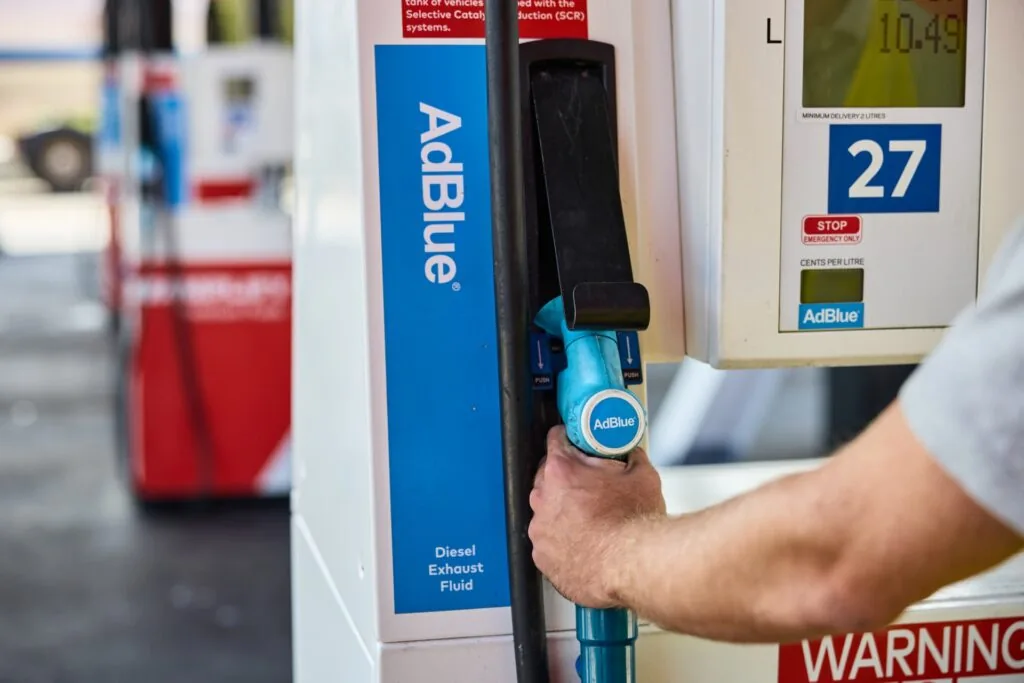
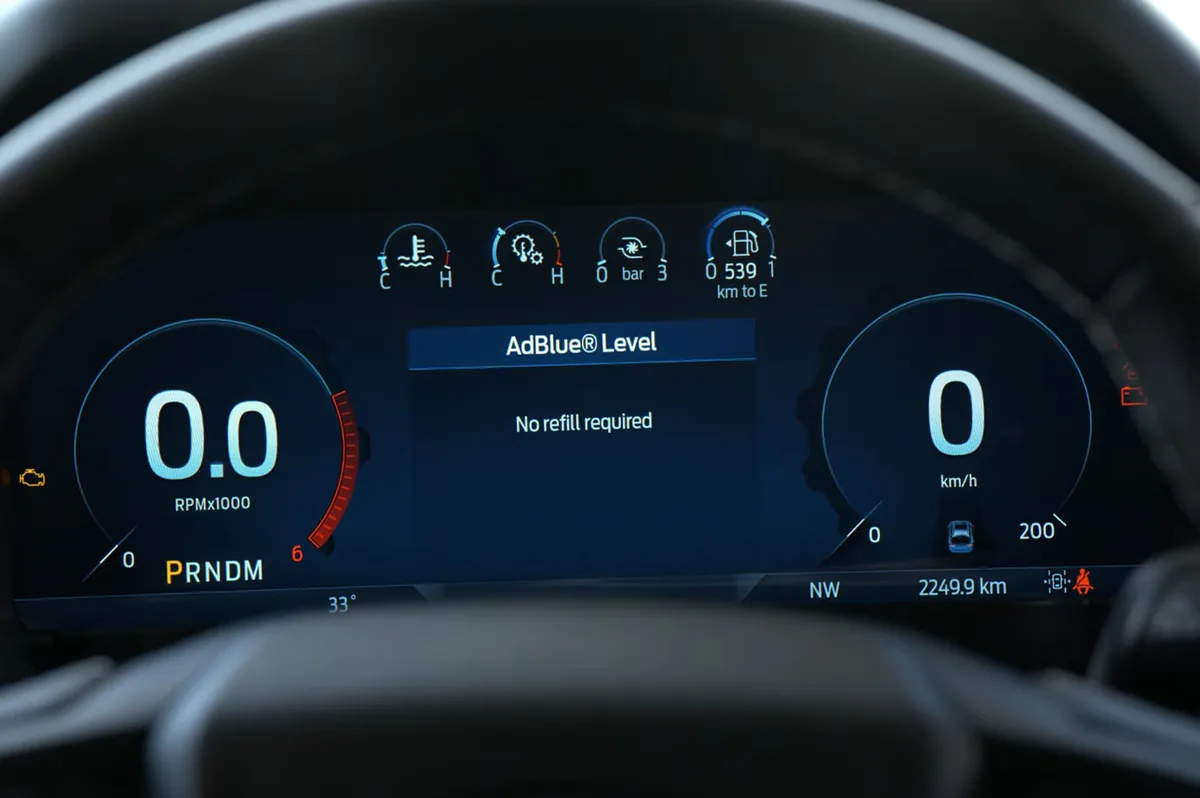
Most vehicles warn you well before the tank runs dry — but a warning light is a worse plan than a delivery schedule.
Sizing your supply
Turning litres into deliveries
Knowing your annual figure is half the job. The other half is deciding how it arrives — and that comes down to how much you use in a month and how much storage you're prepared to give it.
Under 150 L a month
Sealed 10L drums. No tank, no pump, no shelf life worries — each drum is opened and used.
150 L – 3,000 L a month
A 1000L IBC with a pump kit. One delivery covers weeks of use and the cost per litre drops sharply against drums.
Over 3,000 L a month
Bulk delivery into your own tank. Lowest cost per litre, no containers to handle or dispose of.
One thing worth building into the plan: AdBlue carries a shelf life of about 12 months stored between 5°C and 25°C out of direct sun, and it degrades faster if it's sitting in a hot yard through summer. Sizing storage to roughly two to three months of use — rather than a year's worth in one go — keeps the product fresh and the working capital free. We'll set a recurring schedule around whatever figure you land on, so nobody has to remember to reorder.
FAQ
AdBlue consumption questions
How much AdBlue does a truck use?
As a working rule, about 5% of diesel consumption. A truck burning 20,000 litres of diesel a year gets through roughly 1,000 litres of AdBlue — one IBC. Older Euro 5 engines often sit nearer 3–4%; Euro 6 engines dose harder and can run at 5–7%.
How many kilometres does a litre of AdBlue last?
That depends on fuel burn, not distance. A prime mover using 55 L/100 km at a 5% dose rate uses about 2.8 litres of AdBlue per 100 km — roughly 36 km per litre. A diesel ute at 11 L/100 km travels closer to 180 km on the same litre.
Why is my AdBlue consumption higher than the calculator says?
Heavy payloads, hills, towing, stop-start city runs, long idle periods and hot weather all raise NOx output, and the SCR system doses to match. Newer engines that lean harder on SCR also use more. If your real figure sits well above 7% of diesel, it's worth having the dosing system checked — a faulty injector or a leaking line shows up as unexplained consumption.
What happens if a vehicle runs out of AdBlue?
The vehicle warns you first, then derates — power and speed are progressively limited, and once the tank is empty many engines won't restart until AdBlue is added. It's a compliance measure built into the emissions system, not a fault, which is why keeping a buffer on site matters more than the cost of the fluid.
Can I use this estimate to get a price?
That's what it's for. Hit "Add these figures to my quote" and your annual litres, diesel usage and dose rate carry across to the quote form — add your suburb and we'll come back with pricing for that volume and a delivery schedule to match.